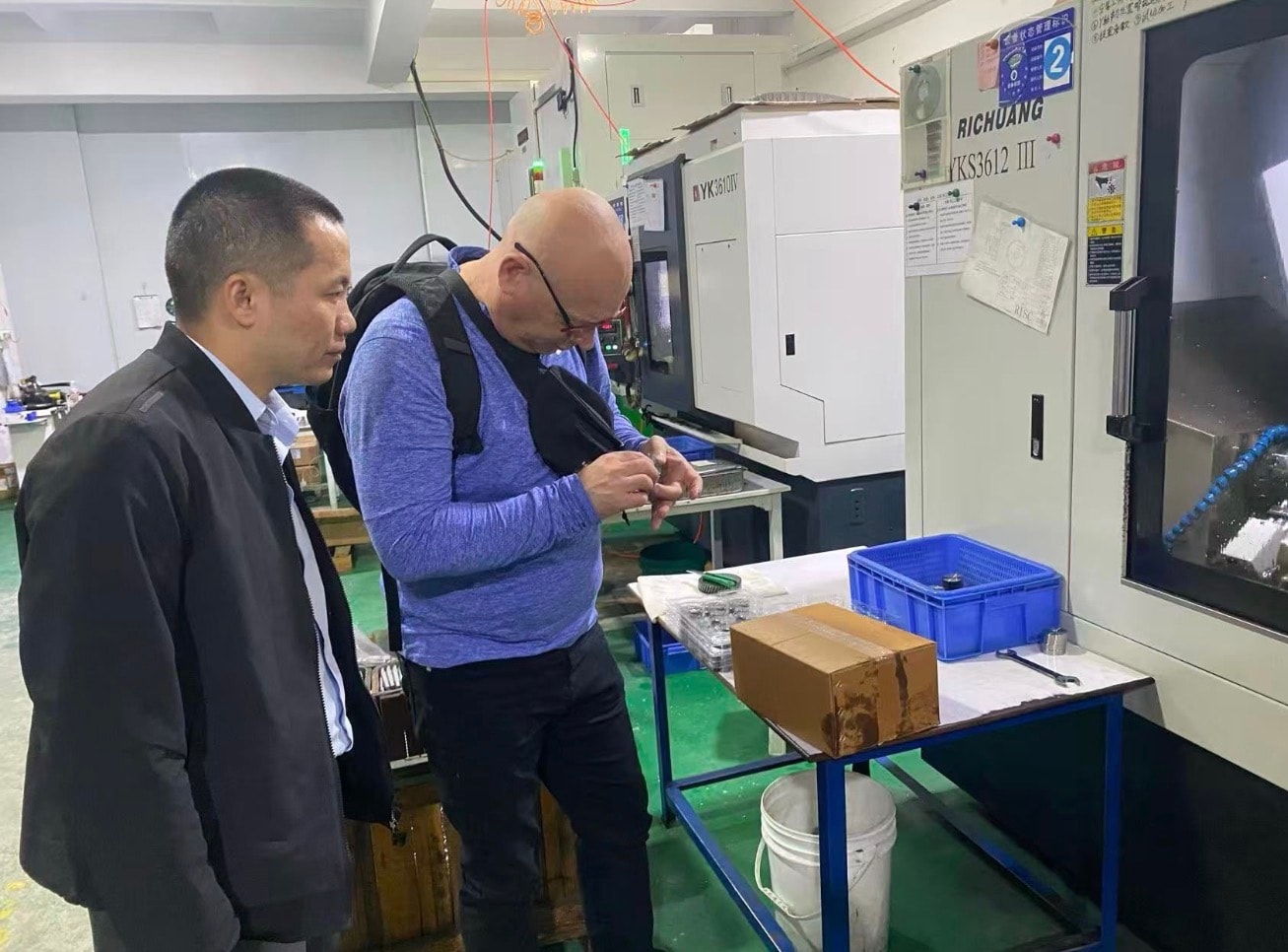
CNC Machining in China for UK Companies
China has a large and capable CNC machining industry. For UK engineering companies, sourcing turned and milled components from China can offer significant cost advantages — but selecting the right factory and managing quality requires a different approach to buying standard products.

China has a large and capable CNC machining industry. Factories range from small workshops with a handful of basic lathes to sophisticated facilities with multi-axis machining centres, CMM inspection equipment, and the capability to produce precision components to tight tolerances.
For UK engineering companies, sourcing CNC components from China can offer significant cost advantages. But selecting the right factory and managing quality requires a more careful approach than buying standard off-the-shelf products.
Engineering Drawings
The starting point for any CNC machining enquiry is a proper engineering drawing. A drawing should specify:
- Geometry — all dimensions required to define the component
- Tolerances — general tolerances and specific tolerances for critical features
- Materials — material specification, grade, and condition
- Surface finish — Ra values or equivalent for machined surfaces
- Threads — thread form, size, pitch, tolerance class, and depth
- Heat treatment — if required, specification and timing relative to machining
- Coatings and surface treatments — anodising, plating, painting, passivation
- Inspection requirements — any specific inspection or testing requirements
A drawing that is incomplete or ambiguous will produce inconsistent quotations and, more importantly, inconsistent components. Suppliers will make assumptions to fill gaps in the specification, and different suppliers will make different assumptions.
If your drawings are not fully dimensioned and toleranced, invest time in completing them before approaching suppliers. The cost of a proper drawing is trivial compared to the cost of receiving components that do not meet your requirements.
Materials
Specify materials precisely. "Aluminium" is not a specification; "6082-T6 aluminium alloy to BS EN 573" is.
For steel components, specify the grade, condition, and any heat treatment requirements. For stainless steel, specify the grade and surface condition. For plastics, specify the material grade and any relevant standards.
Be aware that material grades and standards in China may differ from UK or European equivalents. If you require a specific UK or European standard, state this clearly and ask the supplier to confirm they can source the material to that standard.
Tolerances
Tolerances have a direct impact on manufacturing cost. Tighter tolerances require more precise equipment, slower machining, and more careful inspection — all of which cost more.
Review your drawings and ensure that tolerances reflect genuine functional requirements rather than default values applied without thought. A tolerance of ±0.01mm on a non-critical dimension adds cost without adding value.
For critical features — bearing fits, thread engagement, sealing surfaces — specify tolerances carefully and ensure the factory has the equipment to achieve and verify them.
CNC Turning and Milling
CNC turning produces cylindrical components — shafts, bushes, pins, fittings, and similar parts. CNC milling produces prismatic components — brackets, housings, plates, and more complex geometries.
Many components require both turning and milling operations. Confirm that the factory has the relevant equipment for your specific component.
Multi-Axis Machining
5-axis and 6-axis machining centres can produce complex geometries in a single setup, reducing the number of operations required and improving dimensional consistency. For complex components, multi-axis capability can be a significant advantage.
Not all factories that claim multi-axis capability have the programming expertise and process knowledge to use it effectively. Ask to see examples of similar components they have produced.
Samples and First-Off Components
Before committing to a production order, obtain a sample or first-off component and inspect it thoroughly against the drawing.
Check all critical dimensions with appropriate measuring equipment. For precision components, this means calibrated instruments — micrometers, bore gauges, thread gauges — not a steel rule.
Retain the approved sample. Ensure the factory retains an identical reference sample. The approved sample is the standard against which production will be measured.
Production Repeatability
A good sample is encouraging. The more important question is whether the factory can produce the same component consistently across a production run.
Factors that affect production repeatability include:
- Tooling — worn or inconsistent tooling produces dimensional variation
- Fixturing — inconsistent fixturing produces positional variation
- Machine condition — worn machines produce less consistent results
- Process control — defined cutting parameters, feeds, and speeds
- Inspection — in-process checking to catch drift before it affects the whole batch
Ask the factory about their process control procedures and how they monitor dimensional consistency during production.
Selecting Factories Based on Capability, Not Just Price
A factory capable of producing simple turned components is not automatically suitable for precision CNC work. The equipment, expertise, and quality systems required are different.
When evaluating factories for CNC work, focus on:
- Equipment — what machines do they have, and are they appropriate for your components?
- Measuring equipment — do they have calibrated instruments capable of verifying your tolerances?
- Similar work — can they show you examples of components with similar complexity and tolerances?
- Quality systems — how do they control and verify dimensional accuracy during production?
A factory that cannot answer these questions clearly, or that quotes very quickly without asking any technical questions about your drawing, may not have the capability you need.
Small and Medium Production Quantities
China's CNC machining industry is well suited to small and medium production quantities as well as larger runs. Setup costs are generally lower than in the UK, and many factories are willing to work with quantities that UK machine shops would consider uneconomical.
For prototype and development quantities, be clear about your requirements and discuss tooling and setup costs upfront.
Working With a China Sourcing Service for CNC Components
For UK engineering companies without experience of Chinese manufacturing, working with a China sourcing and manufacturing service that understands precision engineering can provide access to suitable factories, technical communication support, first-off inspection, and production monitoring — reducing the risk of receiving components that do not meet your specification. Sauce Asia provides this as part of a complete UK-managed sourcing service for CNC and precision components, from factory selection and sampling through to quality inspection and UK delivery.
See our CNC machined parts capabilities for detail on the tolerances, materials and processes we work with.
Related Articles
- Manufacturing in China From Engineering Drawings
- Quality Control in China: A Practical Guide for UK Importers
- Metal Fabrication in China: A Guide for UK Buyers
Sourcing CNC Components From China?
Sauce Asia has experience sourcing CNC turned and milled components from China for UK engineering companies, including 5-axis and 6-axis machined parts. We manage the process from factory selection through sampling, production monitoring and quality inspection.
Contact Sauce Asia to discuss your requirements.
Colin Moore has worked with Chinese manufacturers since 1999 and leads Sauce Asia's client relationships and sourcing strategy. Sauce Asia supports UK businesses with supplier sourcing, manufacturing, factory audits, production management, quality inspection and shipping from China.